Omega-3 Fatty Acids and supporting dietary considerations.
A lot of mixed reports on the efficacy of omega-3 continue to circulate alongside unhelpful statements about rancid oils being sold etc. Here is a summary of the research we are currently finalising for our BRAIN diet which will be published in the coming months. Below we present some critical, up-to-date and not widely publicised points which really are key in maximising the benefits of omega-3.
If you find it too technical, there is a summary at the top and recipes which are designed to maximise omega 3 efficacy at the bottom, bon appétite!
Recipes
Disclaimer: in no way does the advice here constitute medical advice. Before starting any dietary or supplement regime be sure to consult your doctor.
Trials of Life has no conflicts of interest or commercial interests in supplements and is currently awaiting a decision on charity status in the U.K.
TL;DR (Too long don’t read)
Key Supporting Nutrients for Omega-3 Efficacy:
Omega 3 absorption and efficacy depends on a number of factors:
- B-Vitamins (B6, B9, B12): Support methylation, neurotransmitter synthesis, and lower homocysteine (1), (5), enhancing omega-3 absorption.
- Phosphatidylcholine (PC): Facilitates DHA transport across the blood-brain barrier and supports cell membrane integrity.
- Vitamin E: Prevents omega-3 oxidation in supplements and tissues, improving efficacy.
- Zinc & Magnesium: Protect brain function, reduce oxidative stress, and support enzymatic processes tied to omega-3 metabolism.
Finding Supporting Nutrients in foods:
- Combine omega-3-rich foods or natural supplements (salmon, anchovies and other fatty fishes, salmon roe, herring roe, algal oil (vegan), krill oil)
- alongside foods high:
- in vitamin E (leafy greens, nuts, olive oil, kiwi, mango etc)
- in zinc ( Oysters, crab, pumpkin seeds, lentils, chickpeas etc)
- in magnesium (Pumpkin seeds, chocolate, bananas, Edamame, etc)
- eggs for choline or soy lecithin or phosphatidylcholine (which aids omega 3 across the blood-brain-barrier).
- alongside foods high:
Other key considerations:
Finding a balance in sources of omega 3 is a good idea. It needs research into your food provenance and careful consideration of protein intake and other micronutrients. Sushi roe is normally either salmon or Masago and is naturally low in mercury and is a nutrient dense food. Algal oil on the other hand is highly sustainable and normally farmed so has no mercury. Many people will take a combination of supplements with a focus in trying to eat some fish each week, but maybe 3 times a week just isn’t achievable or you might be worried about sustainability and contaminants.
- Fatty fish, roe (salmon and herring are best) and krill oil contain phospholipids which are more bioavailable. (Roe is naturally low in mercury and other contaminants
- For supplements look for 2:1 or 3:1 EPA to DHA ratio
- Supplements which include triglyceride vs. ethyl ester form
- Omega 3 in nuts is ALA this only converts to:
- ALA to EPA: ~5-10%.
- ALA to DHA: ~0.5-5%.
- 1000mg of omega 3 is a safe and effective dose but risk of Atrial Fibrulation has been found in very few studies above 1000mg for those in risk groups (so always see your doctor particularly if you have any heart health risks).
- Some studies have used much higher doses up to 5000mg per day; expert Rhonda Fitzpatrick PhD is reported to find the sweetspot about 3000mg, but supplementation must play against diet.
- Mercury in fish is increasingly a problem so small fish species or ethically farmed fish are better (some supermarkets provide details of their fish stocks If choosing farmed salmon, look for organic, sustainably farmed sources with controlled feed.). Wild Salmon is of course preferable as it is normally lower in Mercury but it can be higher in Polychlorinated Biphenyls) and dioxins( toxic environmental pollutants ). The roe of salmon and trout is normally much lower in mercury as the eggs do not have enough time to accumulate much mercury which also normally accumulates in the muscle tissue of the fish.
- algal oils however (7) are mostly farmed and are mercury free and therefore healthier and more sustainable.
- While cutting out fish seems logical, seafood and fish is high in many other key nutrients i.e. Iodine & Selenium (Essential for Thyroid & Brain Health)
- Seafood is the best natural source of iodine, which supports thyroid function.
- Selenium in fish helps reduce mercury toxicity & supports brain health.
- Algal oil doesn’t provide these minerals.

Lets look at the science in a bit more depth.
We featured a quite in-depth analysis of Omega 3 because it is the most widely cited substance connected to improvements in overall cognition advantages and ADHD symptoms improvement. After all if we consider that EPA (eicosapentaenoic acid) and DHA (docosahexaenoic acid) are the two primary omega-3 fatty acids found in the brain it is clear that close management of their intake in our diet has to be essential for an optimal functioning brain.
- Omega 3 supplements for ADHD should focus on EPA and DHA combinations; ideally 2:1 EPA to DHA (6)
- DHA makes up about 30-40% of the total fatty acids in the brain and 10-20% of brain lipids. DHA is critical for brain development, signaling, and plasticity.
- EPA, is less concentrated than DHA in the brain but it is key for ADHD. Its role is more focused on reducing inflammation and supporting neural communication and modulation of neurotransmitter activity (e.g., serotonin and dopamine) and emotional regulation.
- Omega 3 ALA is worth a mention as ALA has its own health benefits, including supporting heart health, reducing inflammation, and improving lipid profiles however while the liver converts it to DHA and EPA the amounts are quite low so for reaching therapeutic levels other sources higher in EPA and DHA are necessary (see sources above).
- Omega 3 in nuts and vegtables is ALA this conversion is:
- ALA to EPA: ~5-10%.
- ALA to DHA: ~0.5-5%.
- Omega 3 in nuts and vegtables is ALA this conversion is:
However, the research has been ambiguous with studies showing moderate to little efficacy and sometimes no significant effect size. Having a deeper understanding of the chemistry and supporting substances we should take with omega 3 shows how we can maximise the positive effects of omega 3 and achieve increased brain health.
Dietary omega-3 and supporting vitamins, minerals and fatty acids.
There is an important interplay that came to light more recently which explains why omega 3 may not have been effective in a fair proportion of studies and this relates to a cycle that sees the interplay and dependence of:
- Reducing homocysteine levels
- The supporting role of B-Vitamins
- Phosphatidylcholine (PC)
- Choline is a precursor for PC
- Vitamin E and antioxidants support
- Zinc and magnesium
If homocysteine levels are high, and there is extensive research linking high homocysteine with ADHD, the B vitamins are often exhausted more quickly as they work to facilitate the breakdown and conversion of homocysteine into other compounds.
- B Vitamins: B6, B9, B12 also support methylation and neurotransmitter synthesis, particularly omega 3 absorption. (1) One study with 3 groups taking supplementations of group 1: vitamin B-12, group 2: fish oil, and group 3:vitamin B-12+fish oil, lowered plasma homocysteine concentrations by 22%, 19%, and 39%, respectively. (2)
- Phosphatidylcholine (PC) is also essential as it serves as a carrier for omega 3 DHA , combining with it to form lysophosphatidylcholine (LPC-DHA), a lipid molecule that has been shown to cross the Blood Brain Barrier (BBB) more efficiently than DHA in its free fatty acid form, aiding transport across the BBB (3) (4). There is higher efficacy of dietary DHA provided as a phospholipid rather than as a triglyceride (4). When homocysteine levels are high the cognitive benefits of omega 3 will not be realised as the levels of B vitamins will have been depleted and will not be present to help form the Phosphatidylcholine.
- Phosphatidylcholine makes up 30-40% of the phospholipids in the brain cell membranes. These phospholipids are essential for maintaining the integrity and fluidity of brain cell membranes, supporting cell signalling, and neurotransmitter function. Phosphatidylcholine is also a precursor for acetylcholine, a critical neurotransmitter involved in memory, learning, and muscle control. At the same time, it also plays a role in supporting liver health, as it supports fat metabolism.
- Choline is a precursor for phosphatidylcholine (PC) with soy lecithin being the highest form of naturally occurring phosphatidylcholine. So introducing foods high in choline can really benefit the brain, as brain cells rely on phosphatidylcholine to maintain membrane integrity, support efficient neurotransmitter signalling, and facilitate overall cognitive function.
- Vitamin E: Omega-3s, particularly EPA and DHA, are highly susceptible to oxidation, which can reduce their effectiveness and potentially create harmful compounds. To reduce oxidation of omega 3 oils buy supplements that include vitamin E; this antioxidant can reduce rancidity in the supplement form and also help prevent oxidation in the tissues of the body. Or you could make sure you try to eat meals which combine omega 3 with vitamin E (see recipe below). If you are taking krill oil not only is it more bioavailable that standard omega 3 oils it is also bound to astaxanthin which acts like vitamin E in way of antioxidant affects.
- Zinc and magnesium: the interdependence of B-vitamins and omega 3 also extends to zinc and magnesium which play key roles in neurotransmission and inflammation. Zinc deficiency causes the brain to be more vulnerable to oxidative stress, also due to a reduced immune defense system and disruption of the blood brain barrier . Magnesium is needed for brain energy metabolism, synaptic signal transduction and general blood flow, but also for magnesium dependent enzyme systems that protect against oxidative DNA damage.
Omega 3 supplement risks of Atrial Fibrulation – There was a meta-analysis showing that risk factors for Atrial Fibrulation increase in at risk populations with higher doses of omega 3. It’s always best for individuals to discuss the potential risks and benefits of omega-3 supplementation with their healthcare provider, especially if they have existing heart conditions or are considering high doses. The safe dose of 1000mg was established for those at-risk populations.
Supporting food combinations
As this article connects to an upcoming diet it would be remiss of me not to suggest recipes, including a vegan recipe, that could achieve the same as those supplements above. Indeed the diet will focus on obtaining maximum essential nutrients through the clinical trial will also pit a trial arm with the diet and supplements against just the diet itself as it is highly probable that certain nutrients need to feature daily and diets alone may not provide enough of certain nutrients i.e. b12, magnesium, zinc etc.
Vegan Omega-3 Bowl

Step-by-Step Instructions:
1. Cook the Quinoa
- Rinse ½ cup quinoa under cold water.
- Cook in 1 cup water (or low-sodium vegetable broth for more flavor).
- Simmer for 12-15 minutes until fluffy. Let cool.
2. Prepare the Tofu
- Cube ½ cup firm tofu and press it with a paper towel to remove excess moisture.
- In a bowl, whisk together the tamari, smoked paprika, garlic powder, olive oil, and lemon juice.
- Toss the tofu in the marinade and let sit for 5-10 minutes.
- Heat a non-stick pan over medium heat and lightly pan-sear the tofu for 3-4 minutes per side until golden. (You can also air-fry at 180°C for 10 minutes for extra crispiness!)
3. Prepare the Greens & Seeds
- Massage the spinach or kale with a little lemon juice & salt for 1-2 minutes to soften.
- Lightly toast the pumpkin seeds in a dry pan for 1-2 minutes until fragrant.
4. Make the Dressing
- In a small bowl, whisk together tahini, lemon juice, garlic, maple syrup (if using), water, salt, and black pepper.
5. Assemble the Bowl
- Base: Add the cooked quinoa to a bowl.
- Veggies: Top with massaged greens, cucumber, and pomegranate seeds.
- Protein: Add the seasoned tofu.
- Healthy Fats: Arrange sliced avocado and sprinkle with ground flaxseeds & chia seeds.
- Crunch: Sprinkle with toasted pumpkin seeds.
- Final Touch: Drizzle the tahini dressing over everything.
- Omega-3 Boost: Pour the algal oil over the bowl just before serving (to preserve DHA & EPA).
For the Tofu Marinade:
- 1 tsp tamari (or soy sauce)
- ½ tsp smoked paprika
- ½ tsp garlic powder
- ½ tsp olive oil
- ½ tsp lemon juice or apple cider vinegar
Dressing:
- 1 tbsp tahini
- 1 tbsp lemon juice
- ½ tbsp maple syrup or honey (optional)
- 1 small garlic clove (grated or minced)
- 2 tbsp water (to thin as needed)
- Salt & black pepper to taste
- 1 tbsp flaxseeds (ground)
- 1 tbsp chia seeds
- 1 cup spinach or kale
- 2 tbsp pumpkin seeds
- ½ cup tofu
- 1 tbsp algal oil
- ½ avocado
- ½ cup cucumber
- ¼ cup pomegranate seeds
- ½ cup cooked quinoa
Vegan Omega-3 Meal Nutritional Breakdown
| Nutrient | Ingredients | Total Amount per Serving | RDA (Men) | RDA (Women) | % of RDA (Men) | % of RDA (Women) |
|---|---|---|---|---|---|---|
| Vitamin A (RAE) | Spinach/Kale | 150-200 mcg | 900 mcg | 700 mcg | 20% | 25-30% |
| Vitamin C | Pomegranate, Spinach/Kale, Cucumber | 30 mg | 90 mg | 75 mg | 33% | 40% |
| Vitamin E | Avocado, Pumpkin Seeds, Spinach/Kale | 4-5 mg | 15 mg | 15 mg | 30% | 30% |
| Vitamin K | Spinach/Kale, Cucumber | 250 mcg | 120 mcg | 90 mcg | 210% | 280% |
| Folate (B9) | Quinoa, Spinach/Kale, Flaxseeds, Tofu | 180-200 mcg | 400 mcg | 400 mcg | 45-50% | 45-50% |
| Choline | Tofu | 120 mg | 550 mg | 425 mg | 22% | 28% |
| Magnesium | Pumpkin Seeds, Chia, Tofu, Quinoa | 220 mg | 420 mg | 320 mg | 52% | 69% |
| Zinc | Pumpkin Seeds, Tofu, Quinoa | 5 mg | 11 mg | 8 mg | 45% | 63% |
| Iron | Spinach/Kale, Tofu, Pumpkin Seeds, Quinoa | 5 mg | 8 mg | 18 mg | 63% | 28% |
| Calcium | Tofu, Chia Seeds, Spinach | 250-300 mg | 1000 mg | 1000 mg | 25-30% | 25-30% |
| Potassium | Avocado, Pomegranate, Cucumber, Quinoa | 750 mg | 3400 mg | 2600 mg | 22% | 29% |
| Omega-3 (ALA) | Flaxseeds, Chia Seeds | 3.5-4 g | 1.6 g | 1.1 g | 218-250% | 318-360% |
| Omega-3 (DHA & EPA) | Algal Oil | 250-300 mg | 500 mg | 500 mg | 50-60% | 50-60% |
Salmon Satay
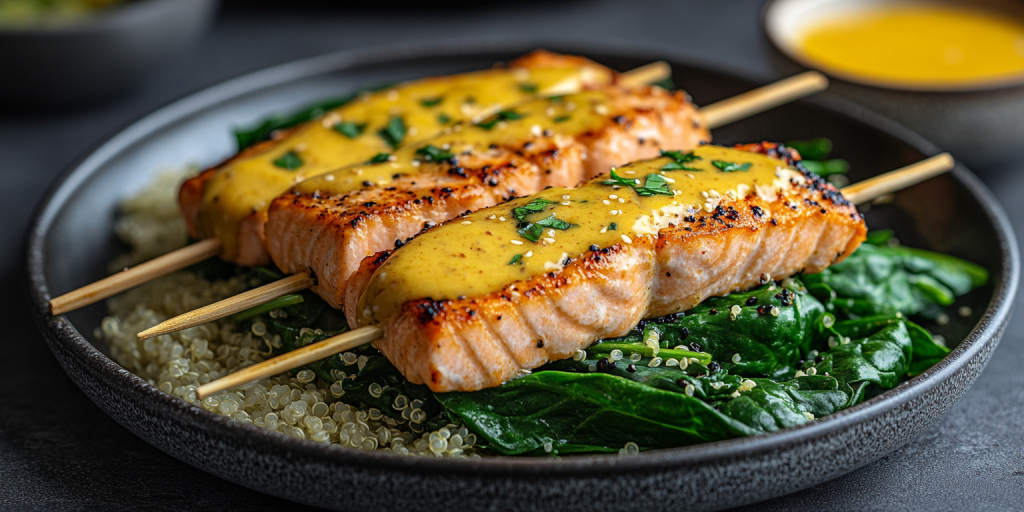
We thought of a dish which would be high in vitamin E and omega 3; and we put together one based upon a tried and tested recipe based on almond butter ; we aimed to focus on almonds as peanuts have too high occurrences of serious allergies, so while the BRAIN diet won’t ever feature peanuts you can replace or complement this dish with peanuts if you know you have no allergies, however almonds are much higher in vitamin E.
Serves: 1
Ingredients
- For the quinoa:
- 1/4 cup quinoa (dry)
- 1/2 cup water
- Pinch of salt
- For the spinach:
- 2 cups fresh spinach
- 1 tsp olive oil
- 1 clove garlic, minced
- For the salmon:
- 1 salmon fillet (100 g)
- 1/4 tsp salt
- 1/4 tsp black pepper
- For the almond satay sauce:
- 1 tbsp almond butter
- 1 tbsp coconut milk (unsweetened)
- 1 tsp soy sauce (or tamari for gluten-free)
- 1/2 tsp honey (optional, for sweetness)
- 1/4 tsp grated ginger
- 1/2 tsp lime juice
- Toppings:
- 1 tbsp chopped almonds
- 1/2 tsp sesame seeds (optional)
Method for Almond Butter Satay Sauce:
-
- Prepare Ingredients: Mince the garlic and grate the ginger if not already done.
- Combine Base Ingredients: In a small bowl, whisk together the almond butter, soy sauce (or tamari), sesame oil, and honey (if using) until smooth.
- Add Aromatics: Mix in the minced garlic, grated ginger, and chili flakes (if using).
- Adjust Consistency: Gradually add the coconut milk, 1 tablespoon at a time, whisking continuously, until the sauce reaches your desired consistency (thicker for dipping, thinner for drizzling).
- Balance Flavors: Squeeze in the lime juice and stir to combine. Taste and adjust the seasoning if necessary (e.g., add more lime juice for acidity, honey for sweetness, or soy sauce for saltiness).
- Heat Gently (Optional): If you prefer a warm sauce, heat it gently in a small saucepan over low heat while stirring, being careful not to let it boil.
- Serve: Use immediately or store in an airtight container in the refrigerator for up to 3 days. Stir before serving if stored.
Key brain benefits:
- Vitamin and Zinc enhance neurotransmitter production for focus and emotional balance
- Vitamin B12 and Omega-3s (EPA/DHA) support neuron protection and efficient signal transmission
- Reduces inflammation and oxidative stress in the brain also through Omega-3s (EPA/DHA), and Vitamin E, a highly effective antioxidant protecting brain cells from free radicals and omega 3 from oxidization.
- Iron and Vitamin B12 improves oxygen and nutrient delivery for cognitive clarity.
- Magnesium and Zinc, Regulates mood, memory, and stress.
Key Nutritional Information
| Vitamin | Ingredients | Total Amount per Serving | RDA (Men) | RDA (Women) | % of RDA (Men) | % of RDA (Women) |
|---|---|---|---|---|---|---|
| Vitamin E | Almond butter, almonds, spinach | 6.2 mg | 15 mg | 15 mg | 41% | 41% |
| Vitamin B6 | Salmon, spinach, quinoa | 0.9 mg | 1.3 mg | 1.3 mg | 69% | 69% |
| Vitamin B12 | Salmon | 3.4 µg | 2.4 µg | 2.4 µg | 142% | 142% |
| Magnesium | Spinach, quinoa, almonds | 150 mg | 420 mg | 320 mg | 36% | 47% |
| Zinc | Salmon, quinoa, almonds, spinach | 2.6 mg | 11 mg | 8 mg | 24% | 33% |
| Iron | Spinach, quinoa, almonds | 4.2 mg | 8 mg | 18 mg | 53% | 23% |
| Omega-3 (EPA/DHA) | Salmon | ~1,200 mg (1.2 g) | N/A | N/A | N/A | N/A |
Soy Lecithin Avocado Smoothie

Ingredients:
- 240ml unsweetened almond milk (fortified with b12 or any other 240ml milk of choice cows milk contains 45–58% of the daily value (based on the RDA of 2.4 µg/day for adults))
- 1 ripe avocado (for creaminess and healthy fats)
- 1 banana (for sweetness, frozen is convenient and often contains higher natural sugars)
- 1 teaspoon soy lecithin granules*
- 1 tablespoon almond butter (for extra healthy fats)
- 1/2 teaspoon cinnamon (optional),
- ½ teaspoon fresh ground ginger**
- Ice cubes (optional, for a colder drink)
Instructions:
- Scoop out the flesh of the avocado and place it in the blender.
- Add the almond milk, banana, soy lecithin, almond butter, and cinnamon (if using).
- Blend until smooth and creamy. If you’d like a colder drink, add some ice cubes and blend again.
- Serve immediately for a delicious and nutrient-packed smoothie.
Key brain benefits:
- ** the ginger helps lower homocysteine while also reducing oxidative damage to cells and tissue.
- *Soy lecithin is often processed using solvents like hexane. If you’re concerned about chemical residues, it’s a good idea to choose organic or non-solvent-extracted lecithin. The choline content from soy lecithin provides a significant contribution (up to 235% of the RDA for women).
- Vitamin E, B6, Folate, and other brain-boosting nutrients are well represented, providing substantial support for brain health, particularly with the combination of ingredients in the smoothie.
- This combination ensures a healthy and balanced intake of essential nutrients, while keeping the RDA percentages within reasonable bounds for most individuals.
Key Nutritional Information
| Vitamin | Ingredients | Total Amount per Serving | RDA (Men) | RDA (Women) | Percentage of RDA (Men) | Percentage of RDA (Women) |
|---|---|---|---|---|---|---|
| Choline | Soy lecithin (1/3 tbsp) | 1,000 mg | 550 mg | 425 mg | 182% | 235% |
| Vitamin E | Almond butter (1 tbsp), Avocado (1/2) | 4.2 mg | 15 mg | 15 mg | 28% | 28% |
| B6 (Pyridoxine) | Almond butter (1 tbsp), Banana (1 medium) | 0.55 mg | 1.3 mg | 1.3 mg | 42% | 42% |
| Folate | Avocado (1/2) | 60 mcg | 400 mcg | 400 mcg | 15% | 15% |
| Vitamin C | Banana (1 medium) | 8.7 mg | 90 mg | 75 mg | 10% | 12% |
| Calcium | Almond milk (1 cup) | 450 mg | 1,000 mg | 1,000 mg | 45% | 45% |
| Vitamin D | Almond milk (1 cup) | 100 IU | 600 IU | 600 IU | 17% | 17% |
| Magnesium | Almond butter (1 tbsp) | 45 mg | 400 mg | 310 mg | 11% | 15% |
| Potassium | Avocado (1/2), Banana (1 medium) | 974 mg | 3,400 mg | 2,600 mg | 28% | 37% |
| Manganese | Cinnamon (1/2 tsp) | 0.6 mg | 2.3 mg | 1.8 mg | 26% | 33% |
Sources:
(1) Effect of vitamin B-12 and n-3 polyunsaturated fatty acids on plasma homocysteine, ferritin, C-reaction protein, and other cardiovascular risk factors: a randomized controlled trial – PubMed Tao Huang et al 2015
(2) Serum Biomarker Analysis in Pediatric ADHD: Implications of Homocysteine, Vitamin B12, Vitamin D, Ferritin, and Iron Levels Xiaoming Jia et al
(3) Role of phosphatidylcholine-DHA in preventing APOE4-associated Alzheimer’s disease – PMC Rhonda P Patrick 2018
(4) Higher efficacy of dietary DHA provided as a phospholipid than as a triglyceride for brain DHA accretion in neonatal piglets Lei Liu 2014
(5) Homocysteine-Lowering by B Vitamins Slows the Rate of Accelerated Brain Atrophy in Mild Cognitive Impairment: A Randomized Controlled Trial – PMC A David Smith et al 2010
(6) Personalised medicine in child and Adolescent Psychiatry: Focus on omega-3 polyunsaturated fatty acids and ADHD – PMC Chang et al 2021